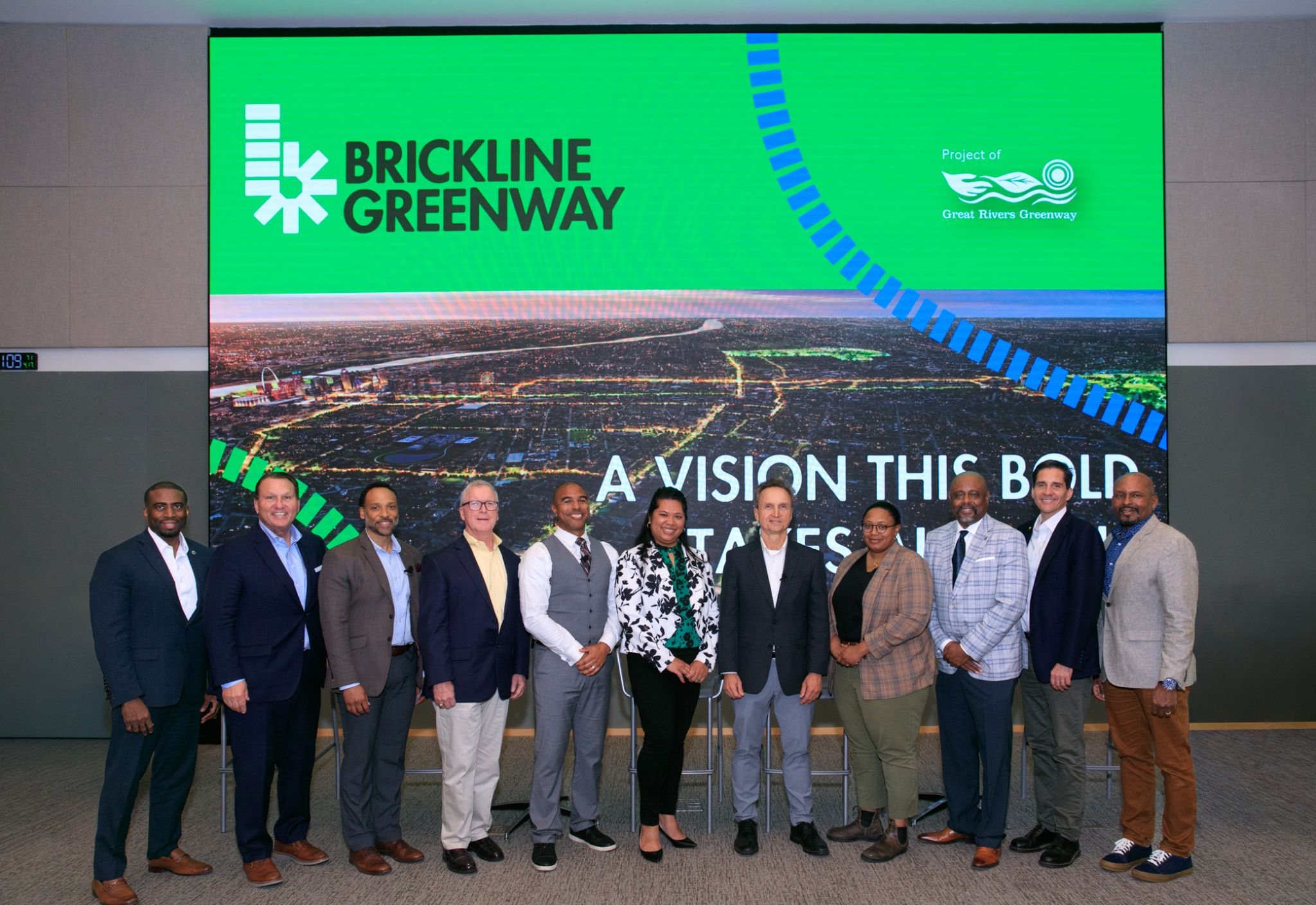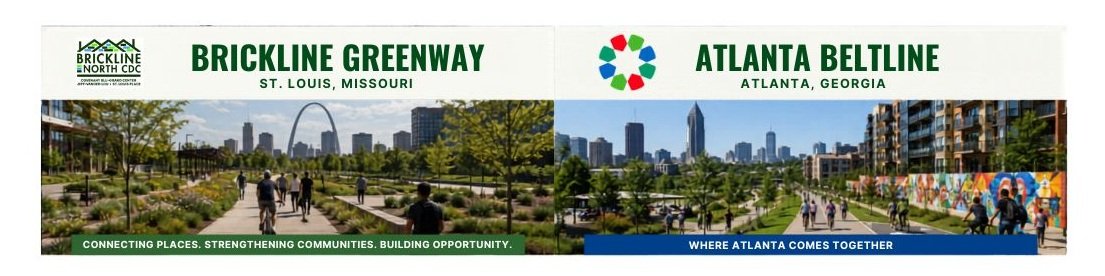
As St. Louis advances the $245 million Brickline Greenway led by Great Rivers Greenway, local leaders are closely studying comparable projects in other cities, especially Atlanta’s BeltLine, to understand both the promise and the risks of large-scale green infrastructure investment. The Atlanta BeltLine has become one of the most well-known examples of how a linear park and transit-adjacent development corridor can reshape an entire city. It has spurred significant private investment, new housing, and cultural activity along formerly underinvested corridors. But it has also drawn sustained criticism for accelerating gentrification and displacing long-time, predominantly Black and low-income residents in adjacent neighborhoods.
That tension is exactly what St. Louis leaders are trying to avoid. The Brickline Greenway is designed to connect major anchors across the region (Forest Park, the Gateway Arch, Tower Grove Park, and Fairground Park) while intentionally linking neighborhoods that have historically been excluded from major investment. In North St. Louis in particular, the project is being framed not just as a trail or beautification effort, but as a long-term economic development strategy.
While the BeltLine generated billions in new investment, it also demonstrated what can happen when development accelerates faster than protections for existing residents. In response, St. Louis leaders say they are deliberately moving more slowly and building stronger community governance systems. A key difference is the creation of the Brickline North CDC, formed to give North St. Louis neighborhoods a formal role in shaping land use, advocating for infrastructure, and guiding future investment along the corridor. Unlike past development patterns that often left neighborhoods without coordinated representation, the CDC functions as a long-term “patient capital” vehicle helping acquire and stabilize property before speculative pressures increase. The CDC supports basic infrastructure and organizational capacity, strategic property acquisition and activates key intersections with community-driven development.
"The region’s fragmented history makes coordination difficult, but it also makes unified projects like Brickline potentially transformative if done correctly." Stephen Westbrooks, SLDC